How much does outsourcing cost?


Robert Cohan
5 minutes read
General
•
Did you know that in a recent study by Deloitte, around 63% of businesses outsource some of their core services?
Outsourcing is becoming increasingly popular as it's a practical way to reduce costs and improve efficiency. If you're not outsourcing yet, you could be missing out on big savings and expert help. In this article, we’ll break down the costs, benefits, and factors so you can see whether or not outsourcing might be a good fit for you.
Understanding Outsourcing

Outsourcing is when companies hire external help to take care of specific tasks, so they can concentrate on their main activities. It's a great way for both the contracting company and the third-party service provider to benefit from specialized expertise and cost efficiency in a mutually beneficial arrangement.
For example, a law firm might engage a third-party provider to manage extensive document reviews as part of litigation, freeing up its in-house attorneys to focus on case strategy. Similarly, in the healthcare industry, outsourcing is often utilized for functions like medical billing and patient record management.
Moreover, mortgage brokerages frequently opt to outsource loan processing and document review in order to streamline operations and handle large volumes of paperwork. By outsourcing these tasks, brokerages can expedite the loan approval process and improve their client service.
Factors Influencing Outsourcing Costs

Outsourcing can be a great way to streamline operations and cut costs, but several factors can influence the final price tag. Here’s a simple breakdown to help you understand how it works.
Outsourcing can be a great way to streamline operations and cut costs, but several factors can influence the final price tag. Here’s a simple breakdown to help you understand how it works.
- Nature of Services:
The type of service being outsourced significantly impacts the overall cost due to the varying levels of complexity, expertise required, and the specific needs of each industry. Services that require more complex and specialized skills typically cost more to outsource.
Simpler tasks like data entry or basic customer service may involve lower costs as they require less specialized knowledge and training.
The level of expertise needed for a service directly affects costs. Services that demand certified or highly trained individuals will be more expensive. For instance, outsourcing medical billing to certified coders or legal research to experienced paralegals is more costly than outsourcing basic administrative tasks.
- Location:
Outsourcing to countries like the Philippines and India is often cheaper due to several key factors. First, labor costs are significantly lower because the cost of living in these countries is much lower.
Where the outsourcing happens can make a big difference in cost. For instance, services outsourced to countries like India or the Philippines often cost less due to lower labor costs. These regions are popular for outsourcing legal research, medical billing, and mortgage processing because they offer a good balance of cost and quality.
Meanwhile, outsourcing within the same country (onshore) might be pricier but offers advantages like easier communication and regulatory compliance.
- Quality and Expertise:
Higher expertise means higher fees. For example, legal firms need skilled legal researchers, and healthcare providers require certified medical coders. These professionals ensure tasks are done accurately and efficiently but charge more for their expertise.
Quality is crucial too. Top-tier providers have strong quality assurance processes, which can increase costs. In fields like finance, healthcare, and legal, accuracy and compliance are vital, and investing in quality services prevents costly errors.
Reputable providers with proven track records may charge more, but they offer reliability and excellence. While higher quality and expertise can be more expensive, they often lead to better outcomes and greater value.
- Volume and Duration:
The volume of work and the duration of the contract significantly impact outsourcing costs. Larger volumes often qualify for bulk discounts, reducing the cost per unit. For example, a legal firm outsourcing eDiscovery for multiple cases can negotiate better rates than for a single case.
Longer contracts typically offer better pricing. A healthcare provider outsourcing medical billing for several years can secure lower rates compared to a short-term project. Consistent, ongoing work provides stability for the service provider, allowing them to offer more competitive pricing.
Negotiating volume and duration terms can lead to substantial savings. By committing to larger volumes and longer durations, businesses can achieve better deals and improve cost efficiency in their outsourcing arrangements.
Getting familiar with these factors can help businesses make informed decisions and optimize their outsourcing strategies for cost efficiency and high-quality results.
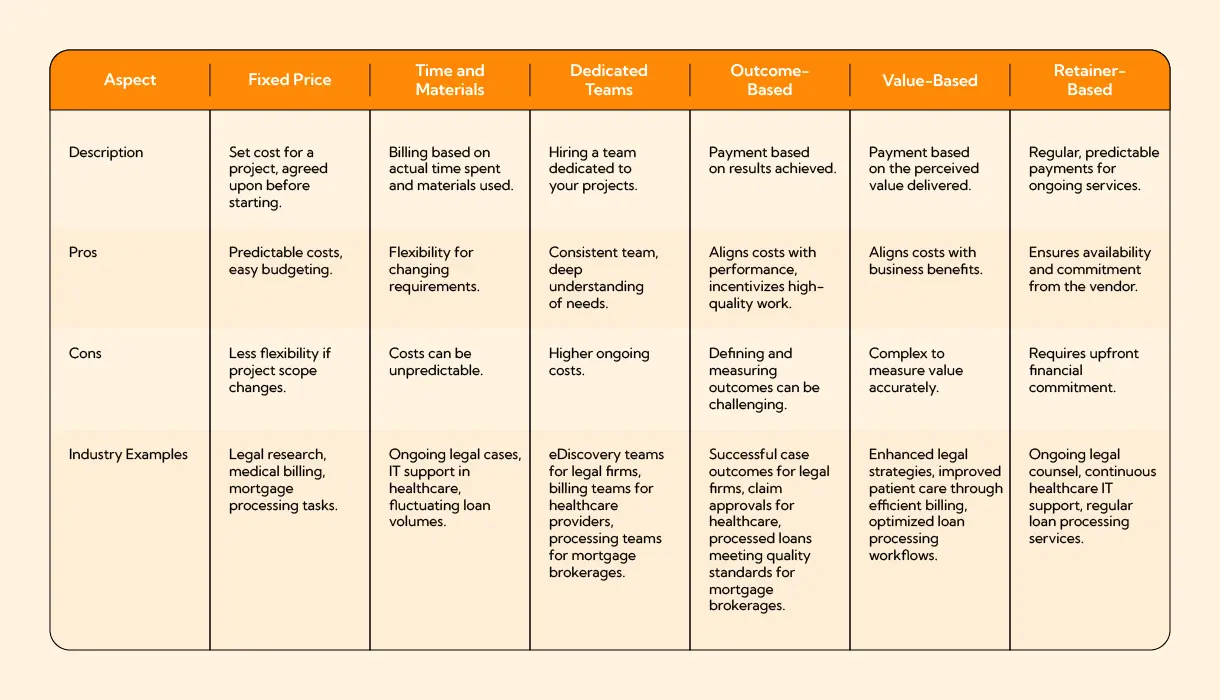
Pricing Models

Breaking Down the Costs: Step-by-Step

When considering outsourcing costs, it's important to examine all expenses. Direct costs include salaries, technology, and infrastructure, while indirect costs relate to management overhead and training. Hidden costs may involve communication barriers, cultural differences, and legal fees. Understanding these components is crucial for effective budgeting and selecting the right outsourcing provider.
1. Calculate expenses for salaries, technology, and infrastructure.
2. Include management overhead and training expenses.
3. Account for potential communication barriers, cultural differences, and legal fees.
4. Recognize unique costs, like compliance for healthcare or technology for legal firms.
5. Sum all direct, indirect, and hidden costs for a complete budget.
Why wait to unlock your company's full potential? Start outsourcing your core activities now and experience the transformative benefits firsthand. The advantages are clear: faster product development, improved quality, and the flexibility to scale operations as needed.
Trust CoreBridge, the leading outsourcing company powered by cutting-edge AI technology, to handle your business needs with unmatched precision and efficiency. Partner with CoreBridge today and take the first step towards a smarter, more efficient, and globally competitive future. Let us help you turn your vision into reality.
General
•
Related Stories